
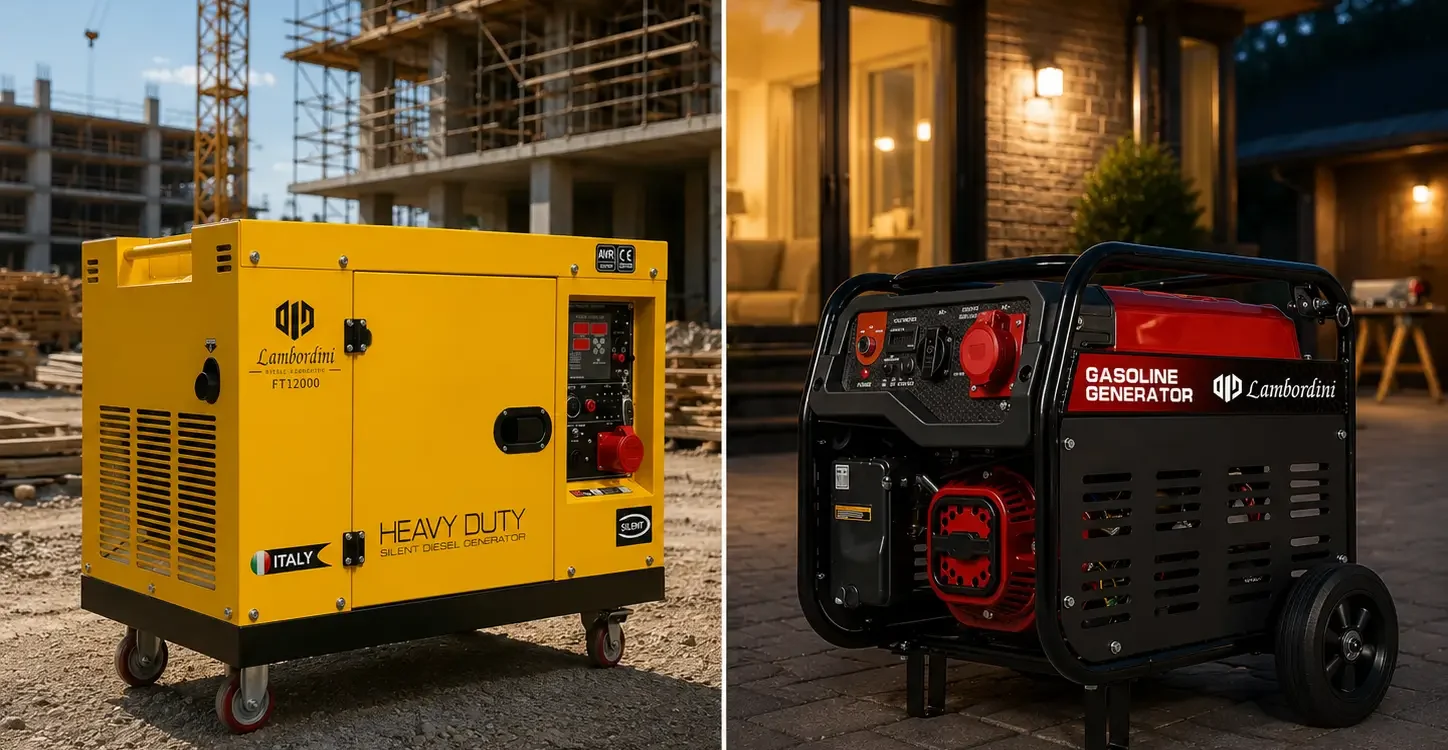
Choosing between a diesel and a gasoline generator is one of the first decisions any buyer faces — and it is one that can significantly affect running costs, maintenance schedules, and long-term reliability. Both fuel types have their strengths, but the right choice depends entirely on your application, location, and how often you need power.
This guide breaks down the key differences so you can make an informed decision.
1. Fuel Efficiency and Running Costs
Diesel generators are considerably more fuel-efficient than gasoline equivalents. A diesel engine produces more energy per litre of fuel — typically 25 to 30 percent more — which makes a significant difference when a generator is running for extended periods.
For continuous or prime power applications — construction sites, agricultural operations, or commercial facilities running generators around the clock — diesel is almost always the more economical choice over time. The higher upfront cost of a diesel unit is typically recovered within months of regular operation.
Gasoline generators, on the other hand, cost less to purchase and are well-suited to occasional or short-duration use. If you need a generator for a few hours during a power outage or to power a weekend event, a gasoline unit offers strong value.
2. Noise Levels
Modern silent diesel generators with acoustic enclosures — such as the Lambordini Closed Frame Diesel Series and Super Silent Diesel Series — can operate at noise levels as low as 65 to 70 dB at 7 metres. This makes them suitable for commercial environments, residential areas, and semi-urban settings where noise restrictions apply.
Open-frame gasoline generators tend to be louder, though portable inverter gasoline generators have improved significantly. The Lambordini PT3500 Portable Inverter Gasoline Generator, for example, operates at 65 dB — comparable to a quiet diesel unit.
3. Maintenance Requirements
Diesel engines have fewer components subject to wear — no spark plugs, no carburettors — which generally means lower maintenance costs and longer service intervals. A well-maintained diesel generator can run for tens of thousands of hours before requiring a major overhaul.
Gasoline engines are simpler and easier to service at a basic level, but carburettor issues, fuel degradation, and spark plug replacement are more common, particularly if the generator is used infrequently or stored for extended periods.
4. Application and Use Case
The right generator type depends heavily on what you need it for:
• Diesel generators are the preferred choice for: standby and prime power for commercial and industrial facilities, construction and infrastructure projects, agricultural operations and cold storage, continuous-duty applications.
• Gasoline generators are better suited to: occasional residential backup, outdoor events, camping and remote use, portable applications where weight and size are priorities.
5. Availability of Fuel
In many markets across the Middle East, Africa, and Asia, diesel fuel is more widely available and more stable in price than gasoline. For buyers operating in remote or developing regions, this is an important practical consideration.
In urban environments and for residential users, gasoline availability is generally good, making it a practical choice for portable or standby home generators.
Which Should You Choose?
If you are powering a business, a construction site, or any operation that demands continuous and dependable power — choose diesel. The running costs, durability, and reliability make it the clear choice for professional and commercial applications.
If you need a portable unit for occasional use, outdoor applications, or light residential backup — gasoline is the more practical and cost-effective option.